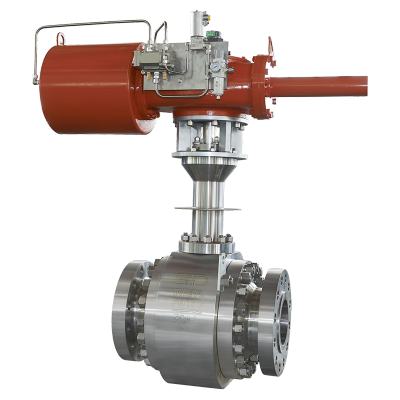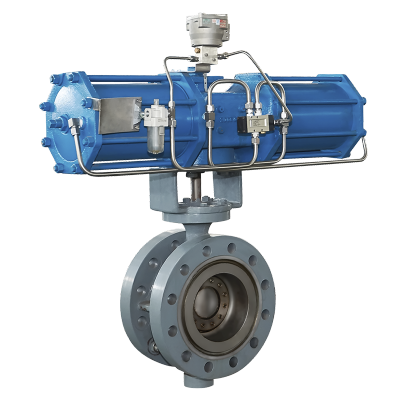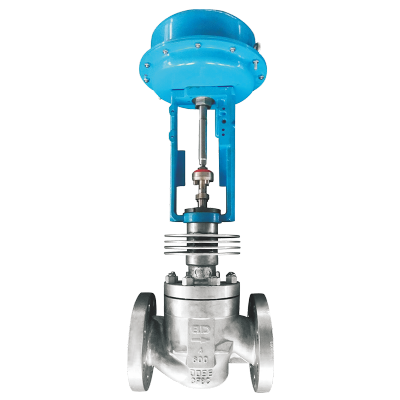


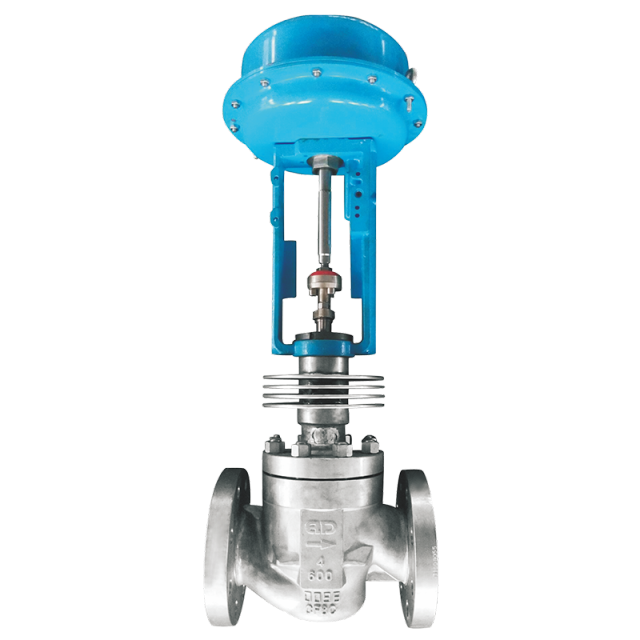
Overview
Regulating Valves are indispensable and crucial equipment in modern industrial facilities. In the fields of petroleum, natural gas, power, chemical engineering, and environmental protection, the environments involved are mostly high-temperature and high-pressure conditions, thus demanding high-quality valves. High-temperature and high-pressure valves have the characteristics of stable operation under harsh conditions, significant pressure reduction effect, convenient maintenance and repair, easy detection and elimination of safety hazards, and cost savings. They possess obvious advantages in terms of structural design, process improvement, and superior performance under harsh conditions.
Design and manufacturing standards and specifications
Design standard:GB4213 IEC534
Valve diameter:NPS1~NPS16 DN25~DN400
Valve pressure:CLASS150~CLASS2500
PN16~PN420
FTF:ISA 75.08.01 ISA 75.08.06 etc.
Connection form:HG/T 20592~20615、ASME B16.5、ASME B16.47 etc.
Inspection: GB/T4213
Drive:Pneumatic, electric, electro-hydraulic linkage, etc.
Application: Chemical industry, petroleum industry, metallurgy, power industry, light industry, etc.
Structural characteristics:
The valve body and valve bonnet are designed with high-temperature and high-pressure resistance capabilities, which can meet the requirements of complex high-temperature and high-pressure special working conditions.
The valve body features a simple and streamlined design, with strong flow capacity and low pressure drop loss.
The valve plug and valve seat are designed with the most optimized approach, meeting various requirements. They feature high adjustment accuracy, wide adjustment range, and low valve noise.
For the same specification of valve, there are multiple Cv values. By simply changing the valve core and valve seat, different characteristic Cv values can be achieved. The structure is simple and the interchangeability is strong.
Adopting a reliable filler design, it features excellent safety and sealing performance, and requires no maintenance.
Adopting a standardized connection method, it can be paired with various types of pneumatic, electric and hydraulic actuators, and the replacement is simple.